
Jun 24, 2026Reducing injury risk during growth spurts in young athletes
An athlete who looked strong and coordinated in June might look noticeably different by October. Their mechanics change, they may not move as smoothly and their landings can look more stiff or uncontrolled. Soon, the complaints follow: heel pain after practice or knees starting to flare up after every tournament weekend.
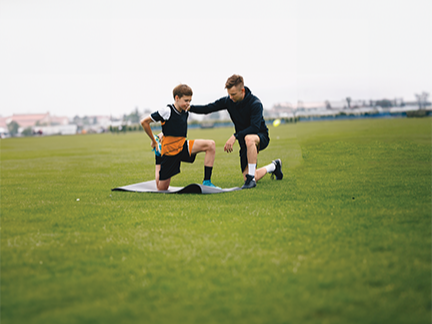
This is not always about skill, effort or coaching; often, it reflects the changes that come with growth.
Rapid growth changes the way young athletes move and recover. During adolescence, bones often grow faster than muscles and tendons can keep up, which can temporarily affect coordination.
At the same time, training demands often continue to increase, and that combination makes growth spurts a prime window for overuse problems, especially around peak height velocity — the period of fastest upward length growth.
The American Medical Society for Sports Medicine found that nearly half of sports injuries in young athletes are overuse injuries, often caused by repeated stress without enough recovery time. Studies show young athletes are more likely to get injured during and just after a major growth spurt. In youth soccer players, the risk remained higher for about six months after their fastest period of growth.
Research also shows that the faster a child is growing, the more likely they are to develop growth-related injuries, with these injuries happening most often around the time of the growth spurt itself.
Some of the most common examples of growth or overuse injuries are Sever’s disease, Osgood-Schlatter disease and Sinding-Larsen-Johansson syndrome.
Sever’s disease is irritation of the growth area at the back of the heel and typically causes heel pain during or after running and jumping, sometimes with limping or tenderness when the heel is squeezed. Osgood-Schlatter disease affects the growth area just below the kneecap, where the patellar tendon attaches to the shinbone. This condition causes pain, swelling and tenderness over the bump below the knee, especially with jumping, sprinting, kneeling or climbing stairs. Sinding-Larsen-Johansson syndrome is similar, but the pain is located at the bottom edge of the kneecap instead of below the kneecap.
So, what can coaches do?
Track growth, not just age. Two 13-year-olds can be in very different biological phases. A simple standing-height check every month paired with quick questions about new pain, soreness, stiffness or a sense of feeling “off” can help identify athletes entering a higher-risk window. Current reviews recommend coaches and clinicians consider an athlete’s growth and maturation, not just what they see during practice and competition.
Reduce load spikes. Growth spurts are not a time to stop training, but they are a bad time for abrupt increases in running, jumping, throwing or tournament volume. Coaches should protect consistency and cut down on any unnecessary training — fewer maximal contacts, fewer back-to-back hard days and more caution with extra teams, showcases or private sessions layered on top. Position statements from the National Athletic Trainers’ Association and the American Academy of Pediatrics recommend at least one to two days off per week from sport-specific training and competition for young athletes.
Keep intensity selective and technique focused. During rapid growth, athletes might temporarily lose some flexibility, coordination, balance and body control. Coaches can respond by shortening high-impact sessions, prioritizing skill quality over sheer repetition and being especially careful with fatigue-based drills that break down mechanics. The goal is not to push through the awkward phase, but to coach and support the athlete through it.
Strength training is key. Supervised resistance training and neuromuscular training are not optional extras for growing athletes; they are an integral part of injury prevention. Well-designed youth strength programs are considered safe when properly supervised and neuromuscular training programs have been shown to reduce lower-extremity injury risk in youth sport. Landing and deceleration mechanics, balance, trunk control and strength in the hips, hamstrings, calves and core all should be trained consistently in practice.
Take recurrent pain seriously. Growth pains are common, however, completely ignoring them can be costly when the pain continues to last. Heel pain, tibial tubercle pain, traction-type hip pain, recurrent “tightness” and persistent soreness that worsens with activity are all reasons to scale back and reassess early rather than weeks later. Coaches do not need to diagnose growth spurt-related injuries, such as apophysitis, but they do need to recognize when soreness is becoming a long-standing pattern.
Build recovery into the program on purpose. Built-in rest days, consistent sleep, varied movement and planned breaks from a single sport should be part of every youth training program, especially during growth spurts. These are not signs of reduced commitment; they are essential for recovery, adaptation and injury prevention. Coaches should not only schedule true off days but also regularly review what recovery looks like outside of practice, including optimal sleep, hydration, nutrition and low-stress movement, such as stretching.
The best coaches recognize when an athlete is going through a growth spurt and adjust accordingly. They pay closer attention, progress training more carefully and understand that rapid growth calls for a smarter, more thoughtful approach. When managed well, not only does this help keep athletes healthy and on the field, but also supports their long-term development.