
Jun 19, 2026Meet the 2026 Most Valuable Athletic Trainers of the Year
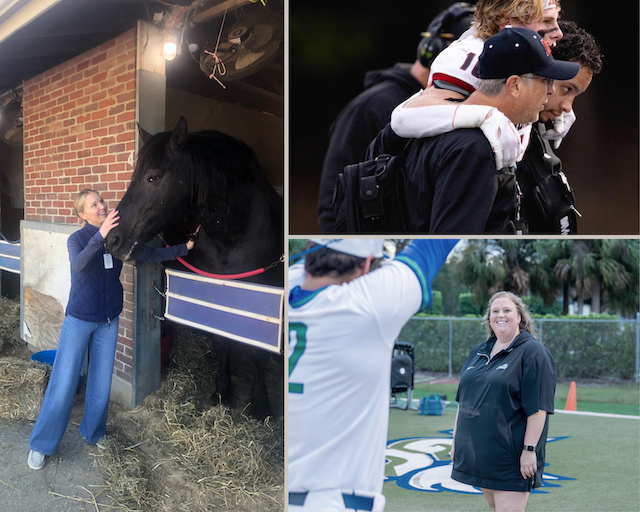
Training & Conditioning’s Most Valuable Athletic Trainer of the Year awards have recognized the efforts of outstanding athletic trainers for more than a decade and highlight the work they do to ensure the health and safety of athletes everywhere.
This year’s honorees represent the best of the profession.
High school honoree Peter Koeniges’ career has spanned more than 30 years, during which he’s continued to prioritize education — both his own and as an assistant professor of kinesiology at Montclair State University in New Jersey — and that knowledge and experience was critical during an emergent medical situation in January.
College honoree Kenna Olsen uses her own experience as a college athlete to inform her approach in the training room, finding joy and purpose in the creativity that comes with developing successful rehab plans while promoting a “student-athlete-first culture” that views athletes as well-rounded individuals rather than simply college athletes.
Finally, our honoree in the nontraditional category, Tiff Haub, has helped develop more formal athletic training care in professional horse racing — a passion project, she said — and has used her administrative position to advocate for athletic trainers, ensuring they have a voice among hospital leadership, while also prioritizing community health needs.
Each of this year’s award winners exemplify the best in athletic training, shining a positive light on an often underappreciated profession and working tirelessly to promote health and safety. Thank you to those who nominated an outstanding athletic trainer. We look forward to continuing to highlight their efforts and accomplishments.
Most valuable high school athletic trainer: Peter Koeniges

Peter Koeniges went to a small high school that didn’t have athletic trainers on staff — or any sports medicine personnel, for that matter — and said he essentially stumbled into the profession.
“I really enjoyed medicine, but I enjoyed sports as well,” he said. “I stumbled into what athletic training was. I didn’t have a mentor. I didn’t have somebody showing me the way. I just figured athletic training sounded good to me.”
Koeniges has been an athletic trainer since 1990 and has spent the bulk of his career at the high school level. Currently, he is an athletic trainer at Northern Highlands Regional High School in Allendale, New Jersey, a role he’s held since 2002.
A few years into his career, Koeniges wanted to explore teaching opportunities. He went back to school and earned a master’s degree in education from Springfield College — an experience that provided the mentorship he missed out on in his high school days.
“The people I had at Springfield College were such great educators,” he said. “They know how to teach. My mentors on this day are my Springfield College people from way back then. They definitely showed me the way and I really thought, ‘Yeah, I’d like to be like them one of these days.’”
That experience also inspired Koeniges in his own role as mentor to up-and-coming athletic trainers. He said he got “a point where students were just so much smarter than I was” as the educational models evolved and the profession changed. In 2021, Koeniges earned a doctorate in athletic training from Moravian University.
“I just found that I was falling far behind as far as mentoring these student athletic trainers,” he said.
Koeniges then had the opportunity to teach athletic training classes at Montclair State University where he has been an assistant professor of kinesiology since September 2025.
In the classroom, Koeniges uses his vast experience to provide an unfiltered look at what a career in athletic training truly looks like.
“There are so many gaps in athletic training education [and] there’s so much information these athletic training students need to know,” he said. “They need to memorize so much. … I use this all the time: When the water jug breaks [at a football practice], you’re the one who’s going to have to fix it. Do you know how to do that?
“I try to bring examples in my classroom, like, ‘This is what we ended up doing. Right or wrong, this is the outcome, this is how it worked.’ That’s just a little bit of real-world experience I can share with my students that they’re able to now bring back to their educational experience.”
Earlier this year, one of those real-world experiences became a life-threatening situation.
During a high school basketball game in January, a 16-year-old player experienced sudden cardiac arrest and collapsed near the bench. Koeniges ran over with an AED he used to shock the player’s heart back into rhythm then performed CPR until help arrived.
According to local reports, Koeniges credited his twice-yearly emergency drills with helping him be prepared for that moment — another example of the importance of continued education.
“The biggest challenge I see is, educationally, there’s just so much they need to know,” Koeniges says of future athletic trainers.
“It’s very difficult to educate them on all those standards in a truncated amount of time. … Having less time but needing to know more makes it more difficult for these students to learn. … As long as they’re able to be flexible and open to continually add more tools to their toolbox, they’ll be OK. I love seeing some of my students getting jobs around me and going from student to colleague.”
Most valuable college athletic trainer: Kenna Olsen

Kenna Olsen knew from a relatively young age that she wanted to pursue a career in sports.
“I was always an athlete and so I knew I wanted to do something in sports and I knew that I wanted to help people,” she said. “Whether it was teaching or something else, I wanted to help people.”
Olsen’s high school offered sports medicine classes that allowed students to attend competitions and function as student athletic trainers, and it was there she fell in love with the profession.
“I’m probably one of a few who went to college and knew exactly what I wanted to do,” she said.
Olsen attended the University of North Dakota where she played softball. She earned a bachelor’s degree in athletic training and a second degree in kinesiology. When she entered the athletic training program her senior year, it only affirmed what she’d always known — this was the career for her.
Olsen joined the Florida Gulf Coast University Department of Athletics in January 2021 and was promoted to head athletic trainer in 2024. She primarily works with the softball and men’s and women’s golf teams as well as oversees the FGCU sports medicine staff.
“Prior to [coming to FGCU], I worked in baseball … but I’ve worked pretty much anything across the board,” she said.
For Olsen, her experience as a college athlete has informed her approach as a college athletic trainer, particularly her experience with injury and rehab. She had two surgeries during her playing days and said that experience allows her to relate to college athletes on a different level.
“To see and experience all the things you feel if you’re an athlete that’s injured and what it’s like to sit and watch your teammates play and do the things you want to do and the things you love doing … it allows me to have that basis of understanding,” Olsen said.
Her experience also led her to adopt and promote a “student-athlete-first culture.”
Athletic trainers often have difficult conversations with coaches and athletes, sometimes delivering news that won’t likely be well-received, but Olsen’s student-athlete-first culture means prioritizing student-athletes and their long-term health and safety.
“Our job innately of our core is to protect the student-athlete,” she said. “That means not being afraid to be the person that says, ‘No, they’re not doing that. No, we’re not pushing that timeline.’
“As a former student-athlete, obviously I’m competitive in my core and … I know they want to compete and to win. [But] whatever you’re going to be as Joe Schmo the individual, the human being, matters just as much if not more than what you do as Joe Schmo the athlete. We have to care about them down the road. … No matter what, it’s always student-athlete first.”
One of the areas of athletic training Olsen loves the most is rehab. It’s of course rewarding to see athletes return to their sport after an injury, but she said there’s a creativity to the rehab process that makes it an underrated part of the profession.
“I think the real beauty in athletic training is being able to do rehab and be creative … and do things that are maybe a little outside the box but still work,” Olsen said. “You can really take a rehab plan or a return-to-play plan and make it individualized to that person.
“Nobody really wants to be in the athletic training room, so whatever we can do to make it still competitive and fun and cater to them is really what we want. … Because a lot of times when you’re (doing) rehab you don’t realize how hard it is. You don’t feel like you’re ever going to get out.”
When they do get out, however, the reward is seeing the growth as an athlete but also as a person.
“To get them to see them be people and grow up when they’re here for four years, even when they’re here for two years, you really get to see that transition of growth and I think that’s really special that you don’t necessarily get that other places or in other settings,” Olsen said. “But the biggest reward is to be able to see them get back on the field or court and do what they love to do.”
“The biggest reward is to be able to see them get back on the field or court and do what they love to do.” — Kenna Olsen
Most valuable nontraditional athletic trainer: Tiff Haub

Tiff Haub started her career in the college setting, working as an athletic trainer at the University of Kentucky and the University of Louisville before taking an opportunity with the Norton Healthcare hospital system in 2020.
“It was the right fit for me, so I took a leap of faith,” she said.
After a year at the hospital, officials at Churchill Downs approached Norton to discuss fulfilling the venue’s medical needs. Previously, there hadn’t been federal guidelines around jockey healthcare and safety and Haub and the Norton staff were tasked with developing some requirements.
“These are professional athletes who are riding a horse at nearly 40 miles per hour,” Haub said. “They’re transient in nature. They’re self-employed, so they’re not on a team where a coach or an organization is overseeing their medical care. … I thought, we can really take the collegiate model I spent 10 years in and just uplift and elevate what they’re doing.”
“Churchill Downs is the mecca of thoroughbred horse racing. It’s known not only in America, but across the world, and they should have the gold standard jockey care at Churchill Downs.”
Every year, Haub said the Norton team has been able to elevate what they’re providing the jockeys, noting that jockey healthcare as a concept didn’t exist five years ago.
The initiative has become a passion project for Haub, who grew up as an equestrian showing horses, and she has taken her athletic training and administrative experience and combined it with her equestrian background to promote jockey health and safety.
“It’s been a passion since Day 1,” she said.
Relationship-building is a major aspect of athletic training, and in working with jockeys, Haub discovered it is even more important in the world of horse racing.
“There was a little bit of a stigma around even just receiving healthcare and injury care and preventative care,” she said. “We knew this industry is very traditional … and that there are so many stakeholders, so we had to also ensure we were respecting the politics of it and just building relationships … to be able to show that we all have the same goals.
“We have to truly build the relationships and show that we’re on the rail at every race. We’re here throughout the entire year and whatever you need, we’re going to help provide that.”
The first year of the program was spent building that foundation as well as becoming “jockey experts.” Haub and her team studied riding, operations and all the stakeholders as well as the biomechanics and physiology of jockeys.
“We did a lot of not only educating, but a lot of being educated,” Haub said.
The result has been the Norton Sports Health Jockey Care Clinic, a facility that provides on-site medical care, injury prevention and rehabilitation for jockeys at Churchill Downs. The clinic started as a first aid site and jockey triage center and has evolved to provide more comprehensive care.
“We want it to be a true wellness recovery center that provides all of access for preventative care, evaluation or recovery all in one place,” Haub said.
An aspect of Haub’s career that goes beyond her work with jockeys is being an advocate for her fellow athletic trainers as well as her community. Part of that includes educating hospital administration, physicians and other sports medicine and orthopedic providers on the value of athletic trainers provide.
“It’s about being informed so that when we’re doing something in sports health, I can say, ‘This is how sports health can contribute to this and be a part of it and be a true partner internally,’” she said. “I think we’ve come a long way, especially in the last 10 years, but getting other allied healthcare or medical providers understanding truly the education and skill set of the profession so they can continue to help support advocacy.
“Great athletic trainers are so empathetic and passionate and caring and lifelong learners and truly do care about the other humans that they’re working with.”